

Does installing an EV charger require a panel upgrade?
Not always. A panel upgrade is only needed when your existing electrical service can’t safely handle the charger’s power draw, the panel has no usable breaker space, or the equipment is outdated or unsafe. Many homes can support a Level 2 charger simply by setting a lower amperage or adding load management — no panel replacement required. A licensed electrician’s load calculation, not the number printed on the main breaker, determines which situation applies.
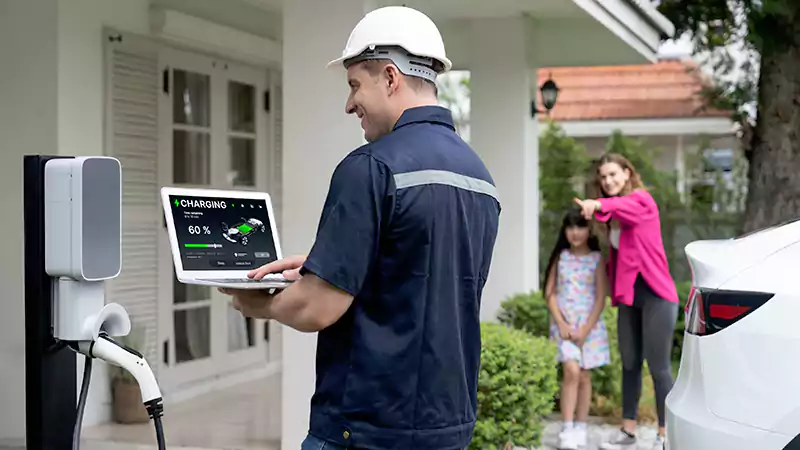
An EV charger installation does not always require replacing or upgrading your electrical panel. Whether your current system can support a charger depends on its available capacity, condition, breaker space, and the charging speed you need.
Do I Need a Panel Upgrade for EV Charger Installation?
You need an electrical panel upgrade only when your existing service cannot safely supply the charger’s required power, the panel lacks usable breaker space, or the equipment is outdated or unsuitable for adding a new circuit. An electrical panel upgrade for EV charger installation should be recommended only after these limitations have been confirmed.
A licensed electrician should perform a load calculation that accounts for the home’s existing electrical demands and the proposed EV charger. This calculation matters more than the amperage printed on the main breaker alone. A 100-amp service may support an appropriately sized Level 2 charger in a home with modest electrical demand, while a heavily electrified home with a larger service may still require load controls or additional capacity.
A useful assessment starts with the amount of energy the vehicle needs each night. A driver covering 25 miles per day may need only a few hours of moderate Level 2 charging. Common residential Level 2 chargers can be set to different amperages, and a lower charging rate may fit within the existing service while still replenishing a typical day’s driving overnight.
Residential Level 2 charging generally uses a dedicated 240-volt circuit, and the installation must comply with the electrical code adopted by the local jurisdiction. Whether an electrical panel upgrade for EV charging is necessary depends on the proposed circuit and the home’s existing electrical demand.
An upgrade is more likely with a 60-amp or heavily loaded 100-amp service; no safe location for the required breaker; an obsolete, damaged, recalled, or deteriorated panel; or service conductors, meter equipment, or utility infrastructure that cannot support the proposed load.
The correct starting point is an electrical assessment rather than an automatic panel replacement. The decision should be based on a documented assessment of the home, the vehicle, and the homeowner’s charging routine.
The phrase “panel upgrade” can also describe several different projects. It may refer to replacing an old panel without increasing the home’s electrical service, increasing the service capacity, replacing the meter equipment, or modifying utility infrastructure. Homeowners should ask the contractor to identify the exact limitation and the exact equipment being changed.
Can Your Current Panel Handle an EV Charger?
Begin by checking the rating on the main breaker, commonly 100, 150, or 200 amps. Then inspect the panel schedule and available breaker positions. These observations provide useful background, though they do not establish whether the service has enough capacity. A 200-amp label does not reveal how much of that capacity is already committed, and an unused-looking breaker slot does not confirm that the panel can accept another circuit.
An electrician should evaluate whether the home has enough electrical capacity, whether the panel can physically and legally accept the circuit, whether the equipment is in suitable condition, and what charging rate the household requires. This evaluation determines whether an EV charger panel upgrade is actually needed.
Electrical capacity is determined through a residential load calculation or another method accepted by the local authority. The calculation considers heating, cooling, cooking equipment, water heating, dryers, lighting, receptacles, and other significant loads, together with the new charging load. Some jurisdictions permit calculations based partly on measured historical demand. Where allowed, an electrician may use utility interval data or an approved monitoring period to show how much capacity the home actually uses.
A Level 2 charger usually requires a dedicated 240-volt circuit. The panel must have an approved breaker position, a suitable bus rating, a compatible breaker, and enough room to install and route the conductors correctly. Some panels contain spaces that are unusable because the equipment has already reached its listed circuit limit or cannot accept tandem breakers.
Age alone does not determine whether the equipment is in suitable condition. The electrician should look for overheating, corrosion, damaged components, loose connections, improper breaker substitutions, missing covers, crowded wiring, water intrusion, previous unpermitted work, and overall working clearance. Warning signs such as buzzing, heat, burning odors, rust, frequent breaker trips, scorch marks, or flickering lights require prompt professional inspection regardless of the EV charger project.
The charging assessment should use the charger’s maximum configured current, the vehicle’s onboard charging capability, average daily mileage, the number of hours the vehicle is normally parked overnight, regular access to workplace or public charging, and other planned electrical projects. These factors can help determine whether an EV charger electrical upgrade is justified or whether a lower charging output will be sufficient.
Ask the electrician to state the highest charging amperage the existing system can support, the charging amperage recommended for the household, and the estimated miles of range that setting can restore overnight. That provides a practical answer instead of a simple yes-or-no conclusion.
What Triggers an EV Charger Electrical Panel Upgrade?
The need for an electrical panel upgrade is determined by the interaction between the home’s electrical demand and the charging plan. The panel’s age or service rating alone rarely provides the complete answer. The decision depends on the electrical system, the desired charging speed, the property layout, and future energy plans.
Existing service size and calculated demand are principal factors. Electric heating, air conditioning, water heaters, ranges, dryers, hot tubs, saunas, workshops, pool equipment, and accessory dwelling units can consume a substantial share of the available service capacity. The calculation must also consider which loads may operate at the same time. An electrical panel upgrade for EV charger installation becomes more likely when the combined calculated demand approaches or exceeds the service rating.
Daily energy requirement helps define an appropriate charging rate. A household that needs 20 kilowatt-hours overnight has different requirements from one that needs only 6 kilowatt-hours. Daily mileage and parking duration should be considered together with the requested charger output.
A 48-amp charger creates a larger electrical requirement than a unit configured for 24 or 32 amps. The higher setting is valuable only when the vehicle can accept it and the household needs the additional charging speed. Charger output must match the circuit, wiring, breaker, equipment instructions, and applicable code requirements.
The main panel, meter socket, service entrance conductors, grounding and bonding system, and utility connection must be reviewed as a complete system. Capacity alone is insufficient when the panel lacks an approved breaker position, has an inadequate bus rating, or is no longer considered serviceable.
The distance to the parking area can affect conductor size, voltage drop, labor, trenching, wall repairs, and the practicality of adding a garage subpanel.
Upcoming heat pumps, electric water heating, induction cooking, solar, battery storage, a second EV, or a home addition may justify designing for more capacity during the current project. In these cases, an electrical panel upgrade for EV charging may also support the homeowner’s wider electrification plans.
Permitting rules, adopted electrical codes, utility standards, equipment listing, and accepted load-management methods vary by location. The National Electrical Code serves as the primary U.S. safety benchmark, though jurisdictions adopt different editions and may add local amendments.
The contractor’s proposal should name the limiting factor. “The panel is full,” “the service lacks capacity,” and “the equipment should be replaced for safety” describe different problems and should lead to different scopes of work.
Charging Without an Electrical Panel Upgrade for EV Charging
Many homes can accommodate a Level 2 charger without replacing the electrical panel. Level 2 describes 208- or 240-volt charging, not one fixed power level. A charger may be configured for a range of outputs, allowing the installation to match the home’s available capacity.
A lower-amperage Level 2 circuit can still provide useful overnight charging. For example, a driver who travels a moderate distance each day may receive enough overnight range from a 16-, 24-, or 32-amp charging configuration. For many drivers, the relevant measure is the energy restored before the next departure rather than the shortest possible charging session.
The car will draw only the amount permitted by the charger and its own onboard charging system. Installing a higher-powered home charger does not make the vehicle charge faster than the vehicle itself allows.
A panel replacement may still be required when the load calculation shows insufficient service capacity, the panel has reached its approved circuit limit, the panel cannot accept a compatible breaker, existing equipment presents a safety concern, or the desired charging output cannot be supported by the current system. Under these conditions, an EV charger electrical panel upgrade may be the most practical, compliant solution.
A licensed electrician should verify the design and obtain required permits. Hardwired installation is often preferred for higher-power or outdoor applications because it avoids receptacle-related connection points, although appropriately designed plug-in installations may also be permitted.
Before approving a panel upgrade, the homeowner can request two designs: one based on the desired maximum charging output and another based on the minimum output needed for routine driving. Comparing those options makes the cost, charging time, and future flexibility easier to evaluate.
Alternatives to an EV Charger Electrical Upgrade
Several alternatives can provide dependable charging without increasing the home’s service capacity. Each option should be evaluated for charging performance, local code acceptance, equipment compatibility, and future plans. These options may help homeowners avoid an unnecessary EV charger panel upgrade.
An adjustable charger can be set to match the circuit and available capacity. The chosen setting should be documented so it is not casually increased later without reviewing the wiring and breaker.
Approved switching equipment can allow an EV charger and a large appliance, such as an electric dryer, water heater, or range, to use the same available capacity at different times. The exact arrangement must be listed, correctly installed, and accepted by the local inspector.
A properly installed 120-volt charging arrangement may cover the needs of drivers with low daily mileage, plug-in hybrids, or regular access to workplace charging.
Scheduled charging can reduce overlap with cooking, cooling, water heating, and other household loads. Scheduling alone does not increase the panel’s rated capacity, so it must be combined with a compliant electrical design where capacity is constrained.
A subpanel can improve circuit organization, provide circuit space closer to the parking area, and simplify the cable route when the main panel has adequate service capacity. It does not create additional utility capacity and should not be treated as an EV charger electrical upgrade that increases the home’s service rating.
Some utilities offer separate EV service arrangements, special rates, or programs that affect installation design. Availability, tariffs, and installation requirements vary by service territory.
A driver who can charge regularly at work may need only a modest home circuit for overnight top-ups and weekend use.
ENERGY STAR and Department of Energy materials identify energy-management, circuit-sharing, measured-load, and lower-power strategies as potential ways to avoid or streamline panel upgrades. Local acceptance remains essential.
The best alternative should meet the driver’s required daily energy demand without relying on unsafe adapters, extension cords, oversized breakers, or unapproved modifications. It should be assessed using a realistic difficult day scenario, such as arriving home with a low battery before a morning trip.
Using Load Management to Avoid an Electrical Panel Upgrade for an EV Charger
Load management controls the amount of power used for EV charging according to the electrical capacity available at that moment. It allows the charger to use more power when household demand is low and less power when other major equipment is operating.
A typical system monitors the home’s total demand. When major appliances are operating, it reduces or pauses the charger. When household demand decreases, charging power is restored. This keeps the combined load within a defined ceiling without requiring the homeowner to coordinate appliances manually and can allow a charger to operate on a service that lacks enough capacity for unrestricted charging at full output.
Smart charging may delay charging until household demand is lower, follow utility time-of-use periods, divide available power between two or more vehicles, set a maximum site-wide charging load, prioritize a vehicle according to departure time or required energy, respond to utility or grid signals where supported, or schedule sessions around solar production.
The distinction between scheduling and active load management is important. Scheduling selects when charging begins. Active load management measures or controls electrical demand as conditions change and enforces a power limit. A timer does not prevent an overload when other appliances happen to run during the scheduled session.
Managed charging can reduce or defer service-panel, transformer, and distribution upgrades by keeping charging within the available capacity. It is especially useful when the home needs reliable overnight charging but does not require the charger to operate at full power during every minute of the session. In suitable homes, this approach can avoid or delay an EV charger electrical panel upgrade.
The equipment must be suitable for the proposed application and installed according to manufacturer instructions. The electrician should confirm that the system and calculation method are accepted by the permitting authority. Essential safety and load-limiting functions should behave predictably if internet connectivity is interrupted.
Homeowners should ask whether the equipment is listed for the intended application, whether it can control the chosen charger directly, what happens when sensors or control components fail, whether it can support a second charger later, and whether a subscription is required for essential functions.
EV Charger Panel Upgrade Costs
The cost depends on what “electrical upgrade” means in the proposed project. Installing a branch circuit, replacing a panel, and increasing utility service capacity are separate scopes of work. Therefore, the cost of an EV charger electrical upgrade can vary significantly between homes.
For a straightforward U.S. home installation that does not require a panel or service upgrade, current federal consumer guidance places Level 2 charging equipment at approximately $400 to $1,000, with installation commonly around $300 to $2,000. Higher charging amperage, long wire runs, difficult access, and electrical upgrades can increase the total.
A basic estimate may include the EV charger, a dedicated breaker, conductors and conduit, a receptacle or hardwired connection, permit and inspection fees, and labor for the circuit installation.
Additional costs can arise from a long route between the panel and parking space; finished walls or ceilings; trenching to a detached garage; larger conductors needed for distance or charger output; concrete, paving, siding, or drywall restoration; grounding and bonding corrections; relocation required for working clearance; utility engineering; disconnect or reconnection; transformer or underground service work; and hazardous material or access complications.
A complete panel or service upgrade can add several thousand dollars. Broad national figures can be misleading because a panel replacement and a utility service capacity increase are not equivalent projects. ENERGY STAR materials note that service upgrades can range from several thousand dollars to much more in complex cases involving extensive utility or construction work. The final cost of an electrical panel upgrade for EV charging therefore depends on the exact limitation being corrected.
Homeowners should request an itemized quote that separates charger equipment, the EV branch circuit, load-management equipment, panel replacement, service-capacity increase, meter and service equipment, utility charges, permit and inspection fees, and building repairs and restoration. This breakdown reveals whether the expensive portion is directly related to EV charging or comes from existing electrical conditions discovered during the project.
Quotes should also state the charger output included in the design. A proposal for a 60-amp circuit should not be compared directly with a proposal for a 30-amp circuit without accounting for the difference in charging performance and electrical scope. The scope of an EV charger panel upgrade should be clearly separated from the cost of installing the charger circuit itself.
Homeowners should also verify utility rebates, state programs, local incentives, and current tax-credit eligibility before approving the project. Eligibility can depend on the charger model, installation date, location, permit status, income, or utility rate plan. Program availability and qualification rules change over time.
When an EV Charger Electrical Panel Upgrade Makes Sense
An electrical panel or service upgrade is appropriate when it fixes a documented safety issue, resolves a real capacity constraint, or supports a defined long-term electrification plan.
An upgrade is generally the safest option when the existing panel is damaged, obsolete, improperly modified, or unable to support the charger through a code-compliant design. In this situation, an EV charger electrical panel upgrade can address both the charging requirement and the existing electrical defect.
Capacity-related reasons may include a load calculation that exceeds the existing service rating, charging requirements that cannot be met through an acceptable lower output, multiple vehicles requiring substantial overnight energy, a household schedule that leaves too little time for managed charging, or utility or local-code restrictions that rule out the proposed alternatives.
An upgrade may also be the most practical investment when the homeowner expects substantial future electrical demand. Coordinating several electrical projects can reduce duplicated permitting, utility coordination, and restoration work. An electrical panel upgrade for EV charger installation may therefore provide better long-term value when heat pumps, electric water heaters, solar equipment, battery storage, or additional EVs are planned.
The project should be designed by a qualified electrician in coordination with the utility and local permitting authority. The design should include a realistic capacity plan. A new 200-amp service may still become constrained when several large loads are added without coordination.
Before approving the work, request written answers to what specific condition requires the upgrade, which parts of the service will be replaced, how much usable capacity the completed project will provide, and which planned future loads are included in the design.
A well-designed upgrade creates usable electrical capacity and resolves documented system constraints. Its value is highest when it forms part of a broader electrical plan rather than serving as an isolated response to one new appliance.
