

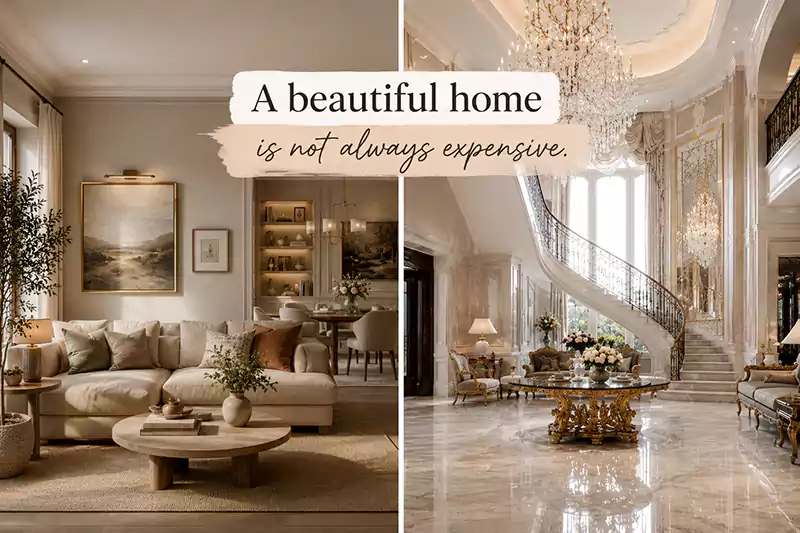
You walk into a home for the first time, and within a second, you feel at ease. What’s there in the home that makes you feel comfortable? Oftentimes, you want to sit down without being told by the host. And then you look around and realize the sofa is from a discount store. And then you notice the walls are painted a simple color. Nothing looks designer or high-end.
Now think about another home you have visited. It has everything expensive, from furniture to upscale showrooms and even marble floors. Moreover, a kitchen that looked straight out of a catalog. And yet, you could not sit on the sofa without being told, as if you were afraid to touch anything.
It has happened with most of us. So, if you are a homeowner on a budget, you must have lived this feeling. When you scroll through home decor accounts online and feel like your space is never going to look the way you want it to. Because you always think it’s expensive, and only expensive homes can look beautiful. You worry about what guests think when they walk through your door.
Here is the truth: the homes people remember most are almost never the most expensive ones. They are the ones that made people feel something. And that feeling has very little to do with money.
Your Brain Decides in Less Than 100 Milliseconds
When you step into a new space, your brain does not pause to evaluate price tags. A study published in the journal Psychological Science found that people form impressions of a space in under 100 milliseconds. Before you can consciously register a single piece of furniture, your brain has already decided how it feels.
What is your brain picking up in that tiny window? It is reading signals. Light levels, color temperature, smell, spatial openness, and visual noise. These are all signals that have nothing to do with how much something costs. They have everything to do with how a space is set up and cared for.
This is good news for anyone who wants a welcoming home on a budget.
Warmth Is a Physical and Emotional Experience
In 2008, psychologists John Bargh and Lawrence Williams at Yale University published a landmark study. They found that people who held a warm cup of coffee rated strangers as friendlier and more generous than those who held a cold cup. Physical warmth changed how people perceived the world around them.
The same effect works in your home. Warm lighting, soft textures, and earthy colors create a physical sensation of warmth. And that physical warmth translates directly into emotional comfort.
A living room with warm-toned bulbs, a woven throw blanket over the arm of the couch, and a wooden side table will feel more welcoming than a room with a spotless designer sectional under harsh white lighting. The research does not lie.
Budget homes with the right warmth signals beat expensive homes with cold aesthetics every single time.
Clutter Is the Real Enemy
One of the most underestimated reasons a home feels unwelcoming has nothing to do with decor quality. It has to do with visual noise.
A well-known study from UCLA’s Center on Everyday Lives of Families observed 32
middle-class families in Los Angeles over several years. They found that mothers in homes with high levels of clutter had significantly elevated cortisol levels throughout the day. Cortisol is the
body’s primary stress hormone. The clutter was making people physically stressed without them even realizing it.
When guests walk into a cluttered space, their brains work overtime to process all the competing visual information. The result is discomfort and a vague need to leave.
The solution is not expensive furniture or a full renovation. It is editing. Remove what does not serve the room. Give surfaces room to breathe. A modest room that is clean and organized will always feel more welcoming than an expensive room that is overflowing with stuff.
You do not need more things. You need fewer, better-placed things.
Natural Light Is Free and Incredibly Powerful
Here is one of the biggest secrets in home design. Natural light does more for a space than almost any expensive upgrade.
A 2019 study published in the journal LEUKOS found that people consistently rated spaces with natural daylight as more pleasant, more spacious, and more inviting than identical spaces with artificial lighting. It was not even close.
Open your curtains fully. Move heavy furniture away from windows. Put a large mirror across from a window to bounce light deeper into the room. These are zero-cost moves that dramatically change how a space feels.
Many modest homes feel absolutely stunning simply because they have bright windows and light walls that make every corner feel alive. That is not an accident. It is an intentional choice that anyone can make.
The Entrance Sets Everything
Research published in the Journal of Environmental Psychology confirms that people form impressions of a home before they even step inside. The exterior, the front door, and the path leading up to your entrance—these all shape how a visitor feels before they say hello.
A clean front porch with a single potted plant and a fresh doormat costs less than $50. But it signals something important. It says someone who cares lives here. That signal alone triggers a sense of welcome before anyone even knocks.
This principle extends to the entire outdoor area around your home. A well-kept, organized exterior creates positive expectations that carry straight inside. For example, homeowners who add a 2-car garage often find that even a functional, budget-friendly structure improves how the whole property feels. Because an organized, intentional exterior tells visitors that the people inside care about their space. And care is the root of every welcoming home.
Scent Is the Most Underrated Tool You Have
Your nose makes decisions before your eyes do.
A study published in the journal Chemical Senses found that people consistently spent more time in spaces with pleasant smells. They also rated those spaces as more comfortable and welcoming. Retail stores have known this for decades. Every Starbucks, every bakery, and every bookshop is engineered around this principle.
You can use it too. A soy candle, a bowl of citrus fruit on the counter, fresh herbs in a jar by the window, or even just a clean laundry scent can shift the emotional tone of an entire room.
And the opposite is equally powerful. A home that smells stale, musty, or like last night’s dinner will feel unwelcoming, no matter how expensive the furniture is. Scent is entirely free to manage. And it affects guests more deeply than almost anything else.
Personal Touches Create Emotional Connection
Think about the most beautifully staged homes you have seen. Everything is positioned perfectly. Colors are coordinated. Every surface is immaculate.
And somehow, it feels cold.
Researcher Colin Ellard at the University of Waterloo spent years studying how people respond to different environments. His work consistently shows that people respond more positively to spaces that feel genuinely lived in. A handwritten note on the fridge. Books with broken spines on a shelf. A child’s drawing in a frame. A quilt passed down from someone’s grandmother.
These things signal that real people live here. Real people who have real stories. And that is what makes guests feel like they belong.
A generic expensive home feels like a hotel lobby. A modest home with real meaning on the walls feels like a place where life actually happens. That is always more welcoming.
Color Does More Work Than People Realize
Color psychology is well-documented in design and behavioral science. And using it well costs nothing extra beyond a can of paint.
Research by the Pantone Color Institute found that color influences up to 85% of a person’s first reaction to a space. Warm tones like terracotta, cream, sage green, warm beige, and golden yellow consistently test as more welcoming than cool grays, stark white, and icy blues.
Many budget homeowners avoid bold warm colors because they worry they look unsophisticated. But the science says the opposite is true. Earthy, warm palettes are exactly what make people feel safe and at home.
A can of quality paint costs around $30. It is one of the highest-return investments any homeowner can make.
The Outdoor Connection Matters More Than You Think
Homes that feel welcoming often have a natural connection between the inside and the outside. This does not require a sprawling backyard or a professionally landscaped garden.
It can be as simple as a window with a view of something green. A back porch with two chairs. A small pot of herbs by the door. Or a covered outdoor area that is clean, usable, and organized.
Roger Ulrich’s landmark study published in Science in 1984 found that even a simple view of a tree through a hospital window reduced patient stress and improved recovery times. People are deeply wired to feel better when they are connected to the natural world. Even the smallest green element in your home or just outside it will make the space feel more alive and welcoming.
Homeowners who invest in practical outdoor improvements, like custom metal carports, often discover that a covered, well-organized outdoor space adds a sense of calm and completeness to a property. It frames the home. It signals that even the functional spaces have been thought through. And that sense of intention is exactly what welcoming homes are built on.
What the Research Is Really Telling Us
Put it all together, and a clear picture emerges.
A 2011 Princeton neuroscience study found that visual clutter reduces the brain’s ability to focus and process information. The more work a space makes your brain do, the less comfortable it feels.
The Yale warmth study shows that physical warmth creates emotional warmth. The UCLA cortisol study shows that clutter causes real stress. The LEUKOS study shows that natural light is more powerful than almost any lighting upgrade. The Chemical Senses study shows that smell shapes experience before anything else registers. And Ellard’s environmental psychology research shows that personal, lived-in spaces connect with people better than staged, sterile ones.
None of these findings involve a renovation budget. They all involve intention.
Simple Things That Actually Work
Here is what research says creates a welcoming home on any budget:
- Warm light bulbs in the 2700K to 3000K range
- Open curtains and mirrors placed to bounce natural light
- Clean, clutter-free surfaces with room to breathe
- Warm wall colors like cream, sage, or terracotta
- A welcoming front entrance with a plant and a doormat
- Pleasant natural scents from candles, herbs, or fresh air
- Personal items like photos, books, and handmade objects
- A cared-for exterior and organized outdoor space
Every single item on that list is achievable without a major budget. All of it requires the same thing: intentionality.
The Takeaway
The homes people feel most comfortable in are not the ones with the most expensive things. They are the ones where someone thought carefully about how the space would feel to the people inside it.
Warmth. Safety. Belonging. Comfort. These are the things people are really looking for when they walk through your door. And every one of those things is created through choices, not costs.
You do not need a bigger renovation budget. You need a shift in focus. Start with the light. Then the smell. Then the clutter. Add some warmth through color and texture. Let your personal story show up on the walls.
Your home does not need to look expensive to make people feel completely at home. It just needs to feel like you thought about them when you set it up.
That is the only design principle that has ever really mattered.
FAQs: Creating a Welcoming Home Without Spending a Fortune
What makes a home feel welcoming without expensive decor?
A welcoming home relies on warmth, natural light, pleasant scents, clutter-free spaces, and personal touches. Research shows your brain forms impressions in under 100 milliseconds based on sensory cues like lighting temperature (2700K-3000K), color warmth (terracotta, sage, and cream), and visual calm—not on furniture price tags.
How does natural light affect how comfortable a home feels?
A 2019 study published in LEUKOS found that people consistently rated spaces with natural daylight as more pleasant, spacious, and inviting than identical rooms with artificial lighting. Open curtains fully, position mirrors across from windows, and move heavy furniture away from light sources to maximize this free resource.
Why does clutter make a home feel less welcoming?
UCLA research found that mothers in cluttered homes had significantly elevated cortisol (stress hormone) levels throughout the day. Visual clutter forces your brain to work overtime processing competing information, creating discomfort. Clean, organized surfaces with breathing room feel more inviting than expensive but crowded spaces.
Does scent really impact how welcoming a home feels?
Yes. A study in Chemical Senses found that people spent more time in pleasantly scented spaces and rated them as more comfortable and welcoming. Simple additions like soy candles, fresh citrus, herbs by the window, or clean laundry scents can shift the emotional tone of an entire room—completely free to manage.
What role does color play in making a home feel inviting?
The Pantone Color Institute found that color influences up to 85% of a person’s first reaction to a space. Warm tones like terracotta, cream, sage green, and golden yellow consistently test as more welcoming than cool grays or stark white. A quality can of paint costs around $30 and offers one of the highest-return investments for home comfort.
How quickly do people form impressions of a home?
Research published in Psychological Science found that people form impressions of a space in under 100 milliseconds—before consciously registering furniture. Your brain reads signals like light levels, color temperature, smell, spatial openness, and visual noise, none of which depend on how much items cost.
Why do personal touches make homes feel more welcoming than staged spaces?
Researcher Colin Ellard at the University of Waterloo found that people respond more positively to genuinely lived-in spaces. Handwritten notes, books with broken spines, family photos, and inherited quilts signal that real people with real stories live there, creating emotional connection. Generic expensive homes feel like hotel lobbies; modest homes with meaning feel like life happens there.
What is the connection between physical warmth and feeling welcome in a home?
A Yale University study by psychologists John Bargh and Lawrence Williams found that people holding warm coffee rated strangers as friendlier than those holding cold drinks. Physical warmth translates directly to emotional comfort. Warm-toned lighting, soft textures like throw blankets, and wooden furniture create this physical sensation that beats cold, expensive aesthetics every time.
How important is the home’s entrance in creating a welcoming feeling?
The Journal of Environmental Psychology confirms people form impressions before stepping inside. A clean front porch with a single potted plant and fresh doormat (under $50) signals that someone who cares lives there. This positive expectation carries straight inside, making the entrance one of the most impactful budget-friendly improvements.
Can outdoor spaces make a home feel more welcoming even on a budget?
Yes. Roger Ulrich’s landmark 1984 study in Science found that even a simple view of a tree through a window reduced stress and improved recovery times. A window with greenery, a small herb pot by the door, or a clean back porch with two chairs creates a natural connection that makes the entire property feel more alive and intentional without requiring a sprawling yard.
